“Experiment is the interpreter of nature. Experiments never deceive. It is our judgement which sometimes deceives itself because it expects results which experiment refuses. We must consult experiments, varying the circumstances, until we have deduced general rules, for experiment alone can furnish reliable rules.”
Leonardo da Vinci
“Vision without execution is a hallucination.”
Thomas Edison
The modern construction industry is highly advanced and well organised. Dating back to thousands of years, some of the earliest known large-scale constructions, like the Egyptian Pyramids, emerged around 2600 BC. These monumental projects required advanced planning, specialised labour, and material management – an early form of the construction process.
As we look at history, several key figures, and civilisations that have shaped the evolution of construction:
- In ancient Egypt, Greece, and Rome, engineers and architects like Imhotep (architect of the Pyramid of Djoser around 2630 BC) laid the foundational practices for construction.
- The Gothic cathedrals of Europe (1100–1500 AD) introduced technical advancements, including flying buttresses and vaulted ceilings, which allowed for larger and more complex structures.
- The modern construction industry took off with the Industrial Revolution. Figures like Isambard Kingdom Brunel, a pioneer of modern civil engineering in England, pushed boundaries with innovations in bridges, tunnels, and railways. New materials, like steel, and machinery enabled the construction of skyscrapers, dams, and railways.
- Visionaries like Frank Lloyd Wright and Le Corbusier influenced the artistic and functional aspects of construction, introducing modernist principles. As a result, the 20th century saw the rise of major construction firms, safety standards, project management methodologies, and sustainability practices. Modern leaders include firms like Bechtel and Skanska and prominent architects and civil engineers who push for innovative, eco-friendly construction solutions.
Today, the construction industry is a global field shaped by advancements in materials, technology (like Building Information Modelling or BIM), and environmental concerns, transforming it into a highly regulated and complex sector.
The integration of AI in Construction and Real Estate presents numerous opportunities as well as significant challenges. On one hand, AI is radically transforming the entire sector by improving efficiency, safety, and innovation; it poses several disruptive challenges on the other.
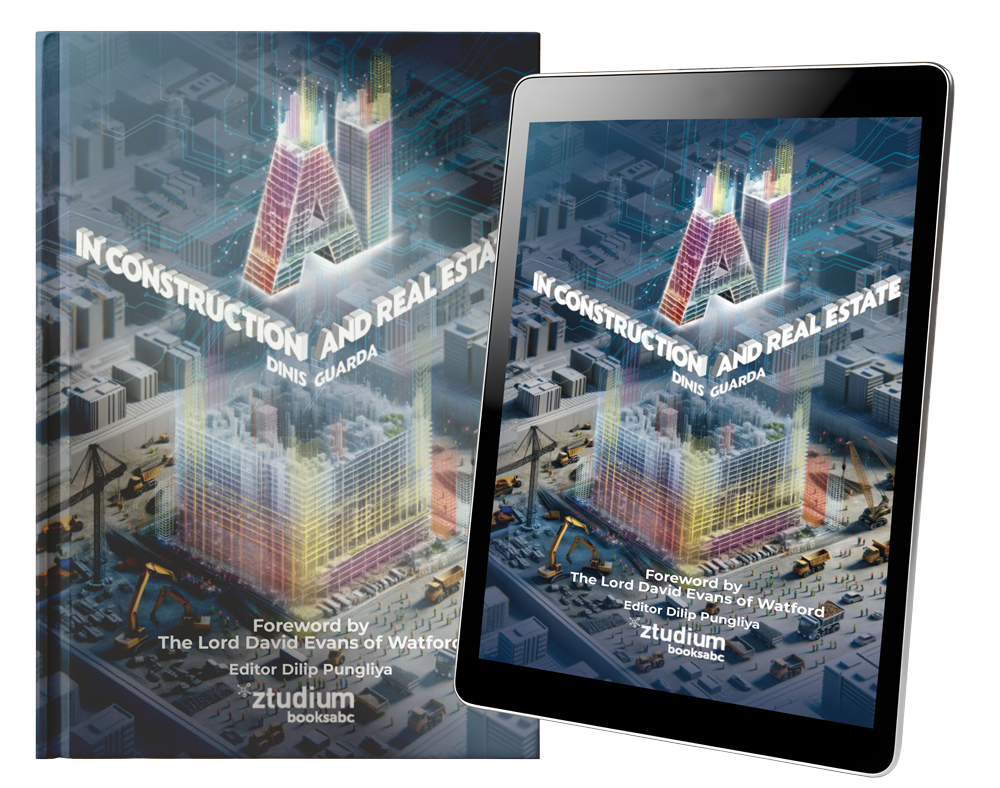
In this book, I will elaborate on a comprehensive breakdown of how AI is now becoming the default setting for all processes in the construction and real estate industry. I rely on research that includes macro data, a look at the opportunities, areas of radical innovation, the challenges, the industry players, and major case studies.
The application and assistance of Artificial Intelligence in Construction and Real Estate has had and will have a major impact, transforming the entire industry 360 – from construction, real estate, architecture and property costs, as well as the present and future prospects, and business and corporate trends.
This book offers an overview of a holistic quantitative research and data collection of work, and its subsequent analysis. In addition, the book further explores the innovative applications of Artificial Intelligence across the entire industry – from construction, real estate, property, and infrastructure.
I deeply explore the role of Artificial Intelligence in the automated management of construction processes, material selection optimisation, and business and legal processes, and its holistic impact. The book also dives deep into how the technologies that are a part of the 4IR, coupled with the potentials of AI, take full control and lead the way to provide detailed explanations with specific cases.
I consider the ethics and legal considerations of using AI, and how it can help predict the impact of the construction industry. For instance, AI tools can be used to identify the wider applications of machine learning algorithms in project management, and the gradual maturity of intelligent sensor systems in building equipment monitoring. At the same time, we analyse the profound impact of Artificial Intelligence on the future development of the construction industry from economic, social, and environmental angles, and put forward corresponding solutions.
The integration of AI into the construction industry is a multifaceted endeavour that requires careful planning and execution. By systematically addressing the considerations outlined in this book, stakeholders can develop a robust blueprint to harness the potential of AI and transform construction processes.
The first phase of this transformation process begins with defining clear objectives and engaging all relevant stakeholders. This ensures that the blueprint is aligned with industry needs and addresses the specific challenges faced by construction companies. A comprehensive assessment of the current state of AI adoption provides a solid foundation for identifying gaps and opportunities.
Technological infrastructure and reliable data form the backbone of successful AI integration. Investing in advanced data analytics platforms, IoT devices, and specialised AI software is essential. Concurrently, developing a skilled workforce through targeted training programs ensures that employees are equipped to leverage these new technologies effectively.
Addressing regulatory and ethical considerations is paramount for building trust and ensuring compliance. Establishing guidelines for data privacy, cybersecurity, and the ethical use of AI helps mitigate potential risks and concerns. Pilot projects serve as valuable testbeds for AI applications, providing insights that guide broader implementation.
Continuous improvement mechanisms, alongside collaboration and knowledge-sharing initiatives, promote a culture of innovation. Funding and investment play a critical role in supporting these initiatives, with public and private partnerships driving progress.
By adhering to this structured approach, the construction and real estate industry can systematically integrate AI, resulting in enhanced efficiency, safety, and sustainability across projects.
Here are some essential points to consider as we welcome you onboard:
- How to outline specific goals for AI implementation in construction, such as improving safety, increasing efficiency, or reducing costs?
- How to identify key areas for AI application? Determine which construction processes could benefit most from AI, like project planning, resource allocation, or quality control.
- How to manage AI data collection and management? Establish a robust system for gathering, storing, and processing construction data, which will be crucial for training AI models.
- Appropriate AI technologies for the construction industry: Select suitable AI techniques (e.g., machine learning, computer vision, natural language processing), best solution providers such as Microsoft Co-Pilot / ChatGPT OpenAI, Claude, AWS, Google Gemini, and appropriate market solutions based on the identified objectives and areas of application in the construction industry.
- How to develop a phased AI implementation plan? Create a step-by-step roadmap for integrating AI into existing construction workflows, integrate with methodologies and frameworks such as BIM, digital twins technology, and ESG, starting with pilot projects and scaling up gradually.
- How to address AI cybersecurity and privacy concerns? Implement strong security measures to protect sensitive construction data and ensure compliance with relevant regulations.
- How to foster collaboration between AI experts and construction professionals? Encourage knowledge sharing and cross-disciplinary cooperation to develop AI solutions tailored to the construction industry’s needs.
- How to invest in AI training and education and use AI for safety? Provide comprehensive training programs for construction workers and managers to ensure they can effectively use and work alongside AI systems. Use AI to improve 2030 UK Net Zero target: all new buildings must comply with Net Zero. Or use AI to prepare and coordinate efforts for 2050 UK Net Zero target: all existing buildings must be retrofitted to comply with Net Zero.
- How to establish and optimise performance metrics with AI? Define key performance indicators (KPIs) to measure the impact of AI implementation on construction projects and overall business outcomes.
- How to plan for continuous improvement in the construction industry using AI? Set up feedback loops and regular evaluations to refine AI models and processes based on real-world performance and changing industry needs.
With the rapid technological progress, Artificial Intelligence (AI) has emerged as a crucial driving force behind transformative changes in various industries. Today, AI not only significantly impacts our daily lives, but also demonstrates exceptional potential and value, especially in the realm of architecture and engineering. The swift development of this technology has not only created unparalleled opportunities for the construction industry, but has also propelled traditional construction models towards more intelligent and efficient paradigms.
The advent of Artificial Intelligence (AI) technologies has penetrated into various fields of society, and its application in the field of construction and engineering has and will bring revolutionary changes to the industry. Construction, engineering processes, budgets, and costs are an important foundation in any construction project. It involves complex legal, financial, regulatory, data processing, precise cost prediction and control, and effective risk management. AI, especially Machine Learning, NLP, Generative AI, with its powerful data processing capabilities and intelligent algorithms, is and will significantly revolutionise while improving the efficiency and accuracy of life cycle of a construction project – starting with the physical and digital design to the architecture, engineering planning, measurements, cost, injecting new solutions, and major vitality and innovative drives into the industry.
As a vital pillar of social progress, the intricate nature and variety inherent in the construction and real estate industry places strict demands on financial models, funding, regulation, architecture, engineering, infrastructure, and technological capabilities. Traditional construction processes face increasingly numerous challenges in design, construction, financial, investment handling and management, such as low efficiency, high costs, funding, and significant safety, and infrastructure risks. However, integrating AI offers radical new innovative approaches to address these issues.
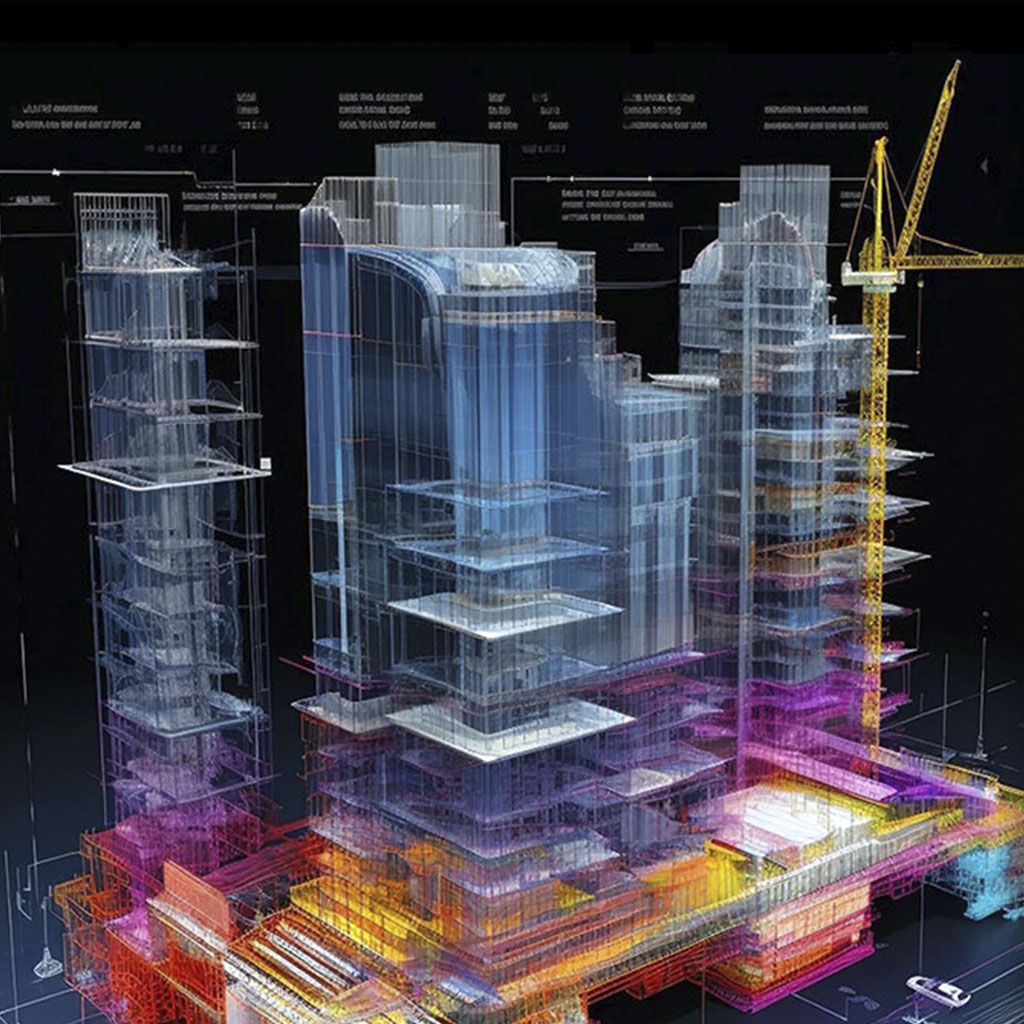
By harnessing AI technologies, the construction and real estate industry and its projects can achieve bigger levels of efficiency, automation and data driven intelligence during the digital design phase—reducing design errors while enhancing efficiency on the physical phase of deployments. During the construction phase, AI can facilitate precise execution leading to improved quality and safety standards, creating digital twins that can help manage the entire life cycle of a building, any construction operation, and even an entire real estate. In terms of 360 management, life cycle of a property, and related operations, AI technology is bringing an entire revolution to the industry, at large. It enables real-time monitoring of building operations while optimising energy usage and reducing operational costs. It also offers new ways to monetise and integrate life cycle, monetise and fund the industry that is driven by data and real time Artificial Intelligence tech products, services and tools.
The challenges will be – How the industry, that is inherently conservative, will be able to change so fast and reskill its works force? Moreover, AI will bring new cybersecurity challenges and risks that were not so present until now or any of the past iterations of the life cycle of the construction and real estate industry at large.
This book elaborates concrete research and material that aims to simplify the present technological innovation coming to the industry. It explains how this disruption can be, first, comprehended and, second, used by all players in the construction and real estate industry. Additionally, this research integrates infographics and statistics, addresses the challenges of AI adoption, reskilling and training, data security, and the ethical considerations, providing a balanced outlook on the future of AI in Construction and Real Estate.
This book works as a blueprint – a framework for integrating artificial intelligence into construction and real estate processes. I divided the book in three parts:
Part 1.
This part highlights and maps and gives an overview of the size of the construction and real estate industry:
- History of construction
- The definition of the terms and industry over of the property, real estate, hospitality, tourism,
- The number and statistics
Part 2
The second part highlights and elaborates on the technologies impacting the construction and real estate industry. It highlights the biggest tech trends and technical developments in the industry. It elaborates on the:
- 4IR – Fourth Industry Revolution;
- The bridges between physical and digital;
- BIM – Building Information Modelling;
- BBIM – New concept I created around Business Building Information Modelling;
- The impact of digital twins;
- The impact and integration of blockchain
- The impact and integration of IOT – Internet of Things
Part 3
The third part highlights and elaborates on the AI revolution in the construction and real estate industry. How AI is redesigning and “eating” the construction industry as a whole.
It displays these foundational areas:
- Blockchain and AI;
- ML – Machine Learning and foundations or Artificial Intelligence;
- AI;
- Smart Cities
- Sustainability ESG
- Disaster and prevention management;
- The future of the industry.
Whether you’re a construction professional, a developer, architect, engineer, real estate investor, or data scientist, AI in Construction and Real Estate will offer a deep dive set of valuable insights into the powerful tools and strategies that can lead to more efficient, profitable, and forward-thinking practices. Welcome onboard!




 See more